

- The issue of weight seems to be one of the most commonly mistaken aspects of medieval combat. Smiths all made swords slightly differently and each fighter had his own preferences. It is impossible to generalize when it comes to the technology of an entire continent from c/ 500-1500 AD, and both very heavy and very light swords existed. In terms of what was typical, though,, here’s a rough guide to averaged:
Single-handed sword (aka sword) - 2.5 pounds
Hand-and-a-half (aka bastard sword) 2.5-3 lbs
Two-hander (aka longsword) - 3 to 3.5 pounds.
The absolute largest swords still rarely hit the 5-pound mark. These were designed to serve very specific tactical functions on the battlefield and were not intended for general-use purposes. Experience showed smiths and warriors that this was the ideal weight range for their weapon. It’s essentially natural selection at work: people whose swords were too light or too heavy went off to battle and didn’t come back. Those with properly weighted swords did. Any heavier and it becomes unwieldy. Any lighter and it lacks the momentum to hit with sufficient force.
Conversely, most Japanese Swords weighed slightly more than European swords relative to their length. Once again, though, keep in mind that this is not a bad thing, nor does it imply that they were slow or relied on brute strength over skill. Quite the opposite, in fact, as the sword's weight gives the fighter the power he needs so he can devote his muscle to technique. Light swords are not very effective when it comes to penetrating any armor, be it plate, chain, or leather. (Fencing foils and other ultralight weapons only came about after gunpowder caused armor to die out, and the heavier two-handers hit their prime when armor was at its fullest.)
In practice, the weight variation is not significant enough that it would make a noticeable difference in combat, but it is there. The Japanese smith would face the exact same system of natural selection as the European one, but due to different environmental conditions the result came out slightly different.
Heavy and cumbersome armor
- A full suit of high quality plate armor weighed on average 55-65lbs. Though there was variation based on the technology available from one century to another or according to one's financial means, this remains a decent rule of thumb from the legionnaires of ancient Rome to knights in full plate to modern Marines. The logic is the same as it was for determining the weight of a sword: You want as much protection as you can possibly afford without it becoming unwieldy. For a well-trained, fit man this limit is around 60 lbs.
There are records in the Middle Ages of people in full plate (i.e. 1350 and later) being able to climb ropes, roll, cartwheel, and even jump onto their horses without using the stirrup. Modern tests confirm these reports.
There are stories about knights needing cranes to get on their horse, or needing squires to help them if the fall on their back. Neither of these stories have any real historical basis. If armor were such a liability, nobody would have worn it, let alone spend a fortune on it. The very fact that it exists in number and for such a long time is proof enough that it is better than going unprotected.
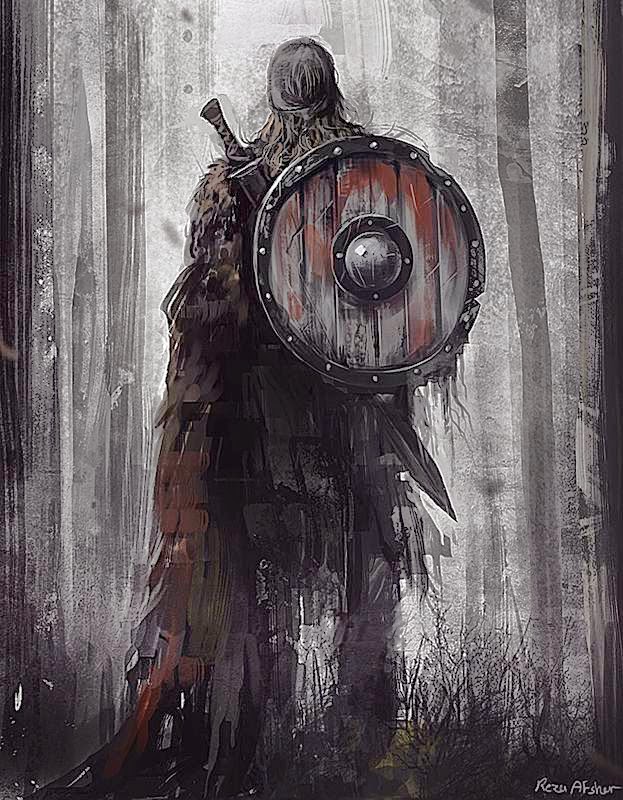
Fighters with swords on their backs
-It is physically impossible for a human to draw a straight, average-length sword from their back while in its sheath. A sword worn on the back is usually curved or short. Cases of back-sheaths were virtually unheard of in Europe and rare elsewhere. (In those cases, the swords were very short. A Roman Gladius or modern machete would still be too long to draw with any degree of comfort.) A fighter might plausible wear a sword in this manner if he had absolutely no intention of fighting any time soon, since it is arguably easier to move around and sit down without it getting in the way.
Archers with quivers on their backs
-This is almost the same as the previous misconception, but it is even more common to hear about. Arrows can be gripped in the middle and are thus possible to draw, but the motion is much more slow and awkward than a draw from the hip, or even better, by sticking the arrows into the ground ahead of time. That being said, images of quivers are still extremely rare in medieval artwork and were simply not used in combat situations in Medieval Europe. Speaking of archers…
Fast and slim medieval archers
- A quality longbow back in the middle ages was made of yew or ash, and needed to have an effective range of up to 300 yards and enough power to penetrate mail. A bow that meets these requirements is going to have a draw weight of somewhere between 120 - 180 pounds. That's like lifting a grown man with three fingers. If anything, an archer was likely to be bigger and stronger than the frontline soldiers. Excavations reveal that the skeletons of medieval archers were permanently warped from the strain of such repeated and imbalanced muscle stress. They did not wear much armor only because archers were never nobility, and therefore couldn't afford any.
Shiny, battle-ready swords
- No matter how well polished, high-carbon steel (the metal swords were made of) just isn’t all that shiny. A common metal for modern decorative swords is stainless steel, which is conveniently rust resistant as well as attractively bright. It is also very hard. Which seems like a good thing, until your realize that so is glass. A real medieval sword has to be able to bend slightly in order to help absorb shock, and a sword that is too hard will be rigid and more prone to snap or shatter. A harder sword can keep a nice straight cutting line and hold an extra sharp edge better, but it also runs the risks mentioned above. The Japanese sword was developed in a less armor-intensive environment, so they can afford to place less emphasis on durability in favor of a keener edge. Often, Japanese swordsmanship techniques involve "using the opponent's energy against them." This is partially because it is an effective technique, but it is also to protect the weapon from taking too many direct hits.
Showing posts with label knights. Show all posts
Showing posts with label knights. Show all posts
Sunday, May 10, 2015
A List of the Best Medieval movies....do you agree?
I found this list of the Best Medieval Movies, you can actually go to the site and up or down vote them. I loved tons of these movies and if you are looking for a good list to have a Medieval Movie power watching session here is a good list. One tip if you have never seen Flesh & Blood with Rutger Hauer you have to watch it, excellent. If there any good movies not on the list you suggest please put it in comments.
The Best Medieval Movies
It is Sunday, Funday.....Medieval Style....It is story time and there be Dragons
Today's post is going to be more geared towards some fantasy images and fun base pictures and links in the Medieval style.
 I saw this picture of this castle in the clouds and could just imagine this could perhaps be the castle of the Dragon lords? That learn the way of the Dragon, and help protect the ancient ones from the Dark powers of the Evil ones.


These Brave knights do not rule the Dragons as no one can ever truly rule a Dragon but fight to uphold the Knights Code taught to them by the wise Dragons. And protect the secret of the Dragon Fire that cannot be loosed upon the world.

They hope one day there will be peace so they can finally go home and lay down their Swords to be with the fair Maidens they love. But alas this is not the time as there must be an Epic Battle of good Vs.Evil.
Their loves patiently wait for them.
Their loves patiently wait for them.


Always looking towards the skies to see if their Brave Knights are returning to them upon the back of a Dragon. Once again there is no sign.

To be continued next week..........
*********************************************************************************
And now I wanted to share a totally epic series by author Michael J. Sullivan who is a fan's best friend. I have personally always got a personal reply from Michael when ever asking him questions about his novels and upcoming work. When I found this series I could not put it down, it is now in my favorites series.....I shared this from Good reads where you can go to learn more and how to get the series. Also note if you add the author as a friend he has always emailed me a free copy of his work (usually a short story but well worth it)!
***********************************************************************
Theft of Swords (The Riyria Revelations #1-2)
(click the link for the original source)
by Michael J. Sullivan (Goodreads Author)
THEY KILLED THE KING. THEY PINNED IT ON TWO MEN. THEY CHOSE POORLY.
There's no ancient evil to defeat or orphan destined for greatness, just unlikely heroes and classic adventure. Royce Melborn, a skilled thief, and his mercenary partner, Hadrian Blackwater, are two enterprising rogues who end up running for their lives when they're framed for the murder of the king. Trapped in a conspiracy that goes beyond the overthrow of a tiny kingdom, their only hope is unraveling ancient mystery before it's too late. (less)

Note there are more books in the series and Michael is currently working on more that will be hopefully available this year!
Friday, May 8, 2015
Truth versus fiction on Medieval weapons and armor

Truth versus fiction on Medieval weapons and armor
Great Article on:
Medieval Misconseptions (click link for original)
Tribute to the wonderful artwork of Edmund Leighton
This is a tribute to the Amazing work of Edmund
Blair Leighton. The pictures are amazing
I could just look at these pictures for hours you really feel like you are
there! If you look at each picture try to look at all the details even in the
background.
Edmund Blair Leighton (21 September 1852 – 1 September 1922) was an English painter
of historical genre scenes, specializing in Regency and medieval subjects.
God Speed is a painting by British artist Edmund Leighton,
depicting an armored knight departing to war and leaving his beloved. The woman
ties a red sash around the knight's arm, which he is meant to return, a medieval
custom which assured both parties that they would be reunited, alive and well.[1] Agriffin on
the banister of the stairs is a symbol of strength and military courage.[1] The knight departs through a castle gate
with portcullis.
The painting was exhibited in the Royal Academy of Arts in 1900.[2]

God Speed was the first of several paintings by Leighton in the
1900s on the subject of chivalry, the others being
The Accolade (1901)
The Accolade (1901)


Tristan and Isolde (1902)


Sunday, May 3, 2015
Got Kids? Get Medieval
Sharing some great info to keep the spark of learning alive with some great books for kids to learn about Medieval life. Sharing from Medievalist.net which is a totally great site!
Got Kids? Get Medieval
– JUNE 26, 2014POSTED IN: BOOKS, FEATURES, TEACHING RESOURCES


 by David MacCaulay (with Sheila Keenan)
 by Justine Ciovacco and Ryan Hobson
 by Andrew Langley
 by Michael Prestwich
Monday, April 27, 2015
More King Arthur....Artwork


The wedding of Arthur and Guinivere

Doomed Lovers....Lancelot and Guinivere perhaps

With Lancelot's Armor

The Training of Morgan Le Fay

Young Arthur
Great medieval, Rennaissance, history, SCA, and Rennaissance Festival websites
Great medieval, Renaissance, history, SCA, and Renaissance Festival websites
http://www.sca.org/ -The Society for Creative Anachronism
http://www.medieval-life-and-times.info/medieval-history/
http://www.medievaltymes.com/courtyard/
http://www.castlesandmanorhouses.com/life.htm
http://besthistorysites.net/early-modern-europe/renaissance/
http://besthistorysites.net/medieval-history/
http://www.ducksters.com/history/middle_ages_timeline.php
-Great for kids
King Arthur
Arthur the boy King who was the only one who could remove the Sword from the stone


The knights of the Round Table
Arthur being Knighted
The lady in the lake giving Excalibur to Arthur


Great sites for Medieval learning

The above link is a wonderful website that gives you all sorts of information on castles. It explains the every day life of living in a castle and so much more.

Below are some great Ren Fest, SCA outfits and warriors.


Here is another wonderful site: http://medieval.stormthecastle.com/ All kinds of learning

Subscribe to:
Posts (Atom)